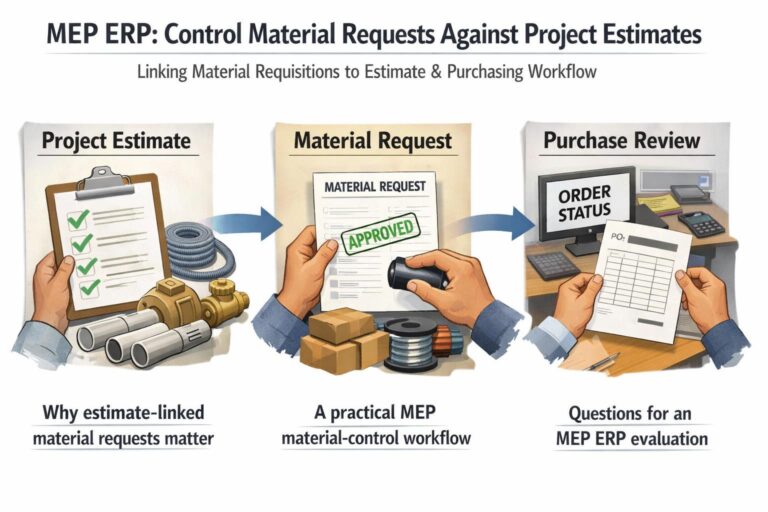


For an MEP contractor, a material request is not only a store or purchasing document. It can also provide important context for the accounting team when project costs are reviewed. A controlled handover connects the requested item, project, activity and accounting classification without treating an approved request as a posted financial transaction.
What the MEP cost handover should preserve
Start with the material requisition (MRQ). BlueberryERP records an MRQ with a unique code and can show statuses such as Pending, Partially Ordered or Fully Ordered. When the request is linked to a project, the workflow can integrate with Project Estimation. The GIAT setting controls whether items are checked against activity and sub-activity totals or against individual items, while Lock Project Estimation Qty helps prevent quantities exceeding the available estimate.
Before an accounting review, the project team should confirm the request code, project, store, item, activity, sub-activity, requested quantity and current lifecycle status. This gives finance a traceable operational starting point. It does not by itself create a journal entry or prove that an item has been received or consumed.
A practical handover sequence for MEP contractors
- Validate the request: confirm the MRQ is linked to the correct project and that the requested quantities agree with the relevant estimation controls.
- Review the operational status: distinguish Pending, Partially Ordered and Fully Ordered requests before interpreting the request as a purchasing commitment.
- Separate physical and financial evidence: match later purchasing, receiving or issue records to the request where available. Do not infer receipt or posting from the MRQ alone.
- Prepare the accounting review: use the project and activity context to help the finance team check the proposed account and classification.
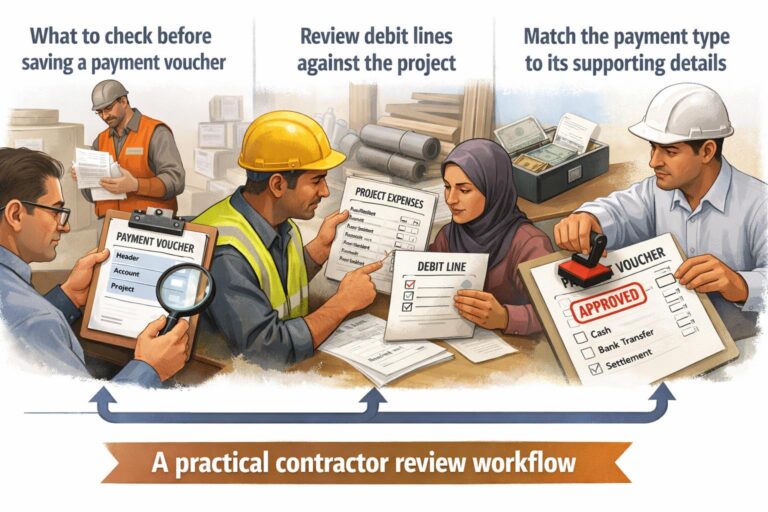
- Review the journal voucher: each journal line requires a valid account, a debit or credit amount, a description and, where relevant, project classification. A line cannot contain both debit and credit.
- Confirm the posting decision: finance should verify that the journal voucher is balanced and supported by the underlying project evidence before posting.
- MRQ validation: identify the MRQ code, project, store, item, activity, sub-activity and requested quantity.
- Project control: check the applicable Project Estimation context, GIAT rule and available estimation quantity where those controls apply.
- Operational status: record whether the MRQ is Pending, Partially Ordered or Fully Ordered; keep requested quantities distinct from later purchasing, receiving or issue evidence.
- Accounting review: use the project and activity context to review the proposed account classification and supporting records.
- Journal decision: check that each journal line has a valid account, description and either a debit or credit amount, and confirm that total debits and credits balance before posting.
The MRQ supplies operational context; the journal voucher remains a separate accounting review and posting decision.
| Stage | Evidence to review | Handover question |
|---|---|---|
| Request | MRQ code, project, item and quantity | Is this the correct MEP requirement? |
| Control | Activity, sub-activity and estimation balance | Does the quantity remain within the project context? |
| Accounting review | Account, project classification and debit/credit lines | Is the proposed entry complete and balanced? |
Questions to ask before finance posts
Can the reviewer identify the originating MRQ? Is the project classification consistent with the work package? Has the team distinguished requested, ordered, received and issued quantities? Does every journal line use a valid account and contain either a debit or a credit, but not both? Are descriptions clear enough for a later review?
These checks help MEP teams discuss project costs using shared evidence. They do not replace the contractor’s accounting policies or professional review. For a broader view of project and material controls, see MEP ERP software and project material controls. Teams can also review the documented construction project cost-centre accounting workflow before assessing their own handover process.