

For UAE contractors, project cost control is rarely lost in one dramatic event. It is usually lost gradually: a purchase commitment is raised above budget, subcontract costs increase, materials are consumed faster than expected, or site costs reach finance before management sees the impact.
\nWhy budget versus actual is not enough
\nA budget-versus-actual report can identify overruns after transactions have already been posted. Contractors also need visibility into committed cost: obligations already created through purchase orders and subcontract commitments but not yet recognized as actual cost.
\nA practical exposure calculation is:
\n\nRemaining available budget = approved budget − actual cost − outstanding commitments
Outstanding commitments should represent the unrecognized balance of valid purchase orders and subcontract obligations. As receipts, invoices or valuations become actual costs, the related commitment should be reduced or closed. Cancelled or superseded commitments should not remain in the calculation. This control view supports investigation, but it does not replace a complete forecast to complete.
\nConnect requisitions, purchasing and receipts
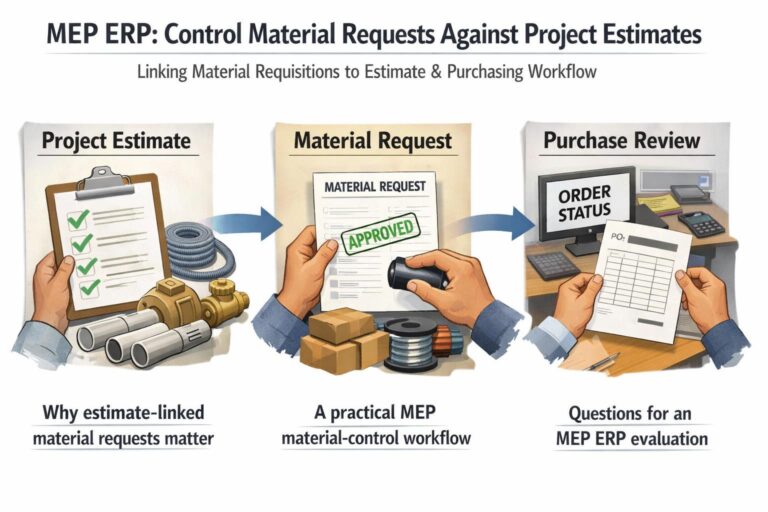
\nProcurement controls create useful checkpoints before a cost becomes an actual transaction. The Blueberry ERP process evidence shows that a material requisition can be linked to project estimation. Its GIAT setting can validate items against activity or sub-activity totals or individual items, while the Lock Project Estimation Qty setting can prevent quantities from exceeding estimation balances.
\nA Goods Received Note must be linked to an approved LPO, and the received quantity cannot exceed the remaining LPO quantity. For a Project LPO, the project is used for the receipt; for Store, Asset or Other LPO types, a receiving store is selected. When a GRN is saved, LPO item balances are updated by the received quantities.
\nThese checkpoints help project, procurement, inventory and finance teams work from connected transaction records, subject to the contractor’s configured workflow and review controls.
\n| Control stage | Supported process evidence | Management check |
|---|---|---|
| Material requisition | A project-linked MRQ can integrate with Project Estimation, with quantity validation against estimation balances. | Is the requested quantity within the relevant project estimate? |
| Approved LPO | An LPO can be created from an MRQ, quotation or manually, and project LPOs can validate against Project Estimation when configured. | Is the purchase document active, approved and linked correctly? |
| Goods receipt | A GRN requires an approved LPO, and received quantities cannot exceed the remaining LPO balance. | Does the received quantity match the remaining order balance? |
| Project cost review | Budget, actual cost and outstanding commitments are reviewed together. | Is remaining available budget sufficient before new expenditure is approved? |
The table describes process checkpoints supported by the supplied Blueberry ERP evidence. It does not replace a contractor’s approval policy, accounting treatment or forecast-to-complete process.
\nA practical project cost control cycle
\n- Confirm the latest approved project budget and approved reallocations.
- Capture open purchase orders and subcontract commitments against the correct project and cost structure.
- Raise material requisitions against the relevant project estimate where applicable.
- Check approved LPOs before recording goods or store receipts.
- Post actual project costs consistently to the same structure.
- Reconcile commitments as receipts, invoices, subcontract valuations, variations and cancellations change the outstanding balance.
- Compare budget, commitments and actuals at the level where managers can act.
- Investigate exceptions before approving new expenditure.
- Review expected cost to complete and forecast project margin.
Where an integrated contracting ERP helps
\nThe strongest control comes when project budgeting, procurement, inventory, subcontracting and accounting use the same project and cost structure. This can reduce spreadsheet reconciliation and give management a more current view of project exposure.
\nBlueberry ERP is built around the way contractors actually work, connecting financial and project processes so contractors can manage cost information within one operational system rather than assembling it manually from disconnected records. Explore the approach on our Construction ERP UAE page.
\nQuestions management should be able to answer
\n- What is the approved budget for this project or cost package?
- How much has already been spent?
- How much is committed but not yet reflected as actual cost?
- Which cost areas are approaching or exceeding budget?
- Are requisition, LPO and receipt quantities aligned?
- What is the likely impact on project margin?
Move from reporting overruns to preventing them
\nProject cost control should not begin after month-end. Giving project and finance teams visibility into budgets, commitments, actual costs and procurement checkpoints creates an earlier decision point while management still has options.
\nWant to see how Blueberry ERP supports contracting project controls? Explore our Construction ERP for UAE contractors, then book a Blueberry ERP demonstration or consultation to review how your budget, procurement and cost-control workflow could be structured in one connected system.